The 92 year old inventor wants to see Safety Receptacles made and marketed in his lifetime, and has made a very unusual proposal.
Because of my age, lack of funds, and health issues (I am headed into Alzheimer’s disease), I have not been able to have the Safety Receptacles manufactured and marketed. My proposal is to give each patent to a company at no charge (free) in exchange for a contract to make and market the receptacle within a reasonable time span. The first to accept this proposal gets to choose which patent they want. I would only ask that a small royalty fee be paid to the charity Compassion International for each Safety receptacle they sell. The amount would be negotiated. I currently support four children through them, two in Dominican Republic, one in Honduras, and one in Ghana. This would ensure that each would be able to complete the program. I would request the second patent acceptor to also pay a similar royalty fee for each Safety Receptacle sold. May the LORD bless each company with prosperity!
ProposalPresenting two patented Safety Receptacle designs that exceed the safety of Tamper Resistant (TR) receptacles and restore the plug-in experience to the ease and simplicity of the old non-safety receptacles.
Tamper Resistant receptacles have been mandated for electrical safety by the National Electrical Code (NEC) for all new construction and renovation. However, many states have not adopted the NEC into law, so the traditional non-safety receptacles are still widely used, creating a danger for small children and the mentally deficient. In this website we show the deficiencies of the TR receptacles and present two patented Safety Receptacle (SR) designs that exceed the safety of the TR receptacles. Prototypes of each design have the same ease of plug insertion as the non-safety receptacles.
Because of my advanced age (92) and lack of funds, producing and marketing of Safety Receptacles is not an option. I would really like to see the SR receptacles produced and marketed in my lifetime, a span which may have been shortened by a recent small stroke. I would gladly license each patent, royalty free (no cost) to a company or qualified persons for a contract to manufacture and market my Safety Receptacles.
I describe this opportunity as disruptive because the public hates the TR receptacles because of their rejection problem.
My interest in receptacles began when a coffee buddy built a house in Michigan and had to use the mandated tamper resistant receptacles. His griping about the receptacles set my mind seeking a solution to the frustrating rejection problem. Both of my safety receptacle designs really do offer the same ease of plug entry as the old non-safety receptacles, and offer excellent safety.
In this website we offer a very brief description of the prototypes of both patent designs, and then we will discuss the shortcomings of the tamper resistant receptacles which are presently mandated by the US Electric Code for all new construction and renovation.
Presenting two patented Safety Receptacle designs that exceed the safety of Tamper Resistant (TR) receptacles and restore the plug-in experience to the ease and simplicity of the old non-safety receptacles.
Tamper Resistant receptacles have been mandated for electrical safety by the National Electrical Code (NEC) for all new construction and renovation. However, many states have not adopted the NEC into law, so the traditional non-safety receptacles are still widely used, creating a danger for small children and the mentally deficient. In this website we show the deficiencies of the TR receptacles and present two patented Safety Receptacle (SR) designs that exceed the safety of the TR receptacles. Prototypes of each design have the same ease of plug insertion as the non-safety receptacles .
Two patented Safety Receptacle designs that deliver better safety with easy plug-in use.
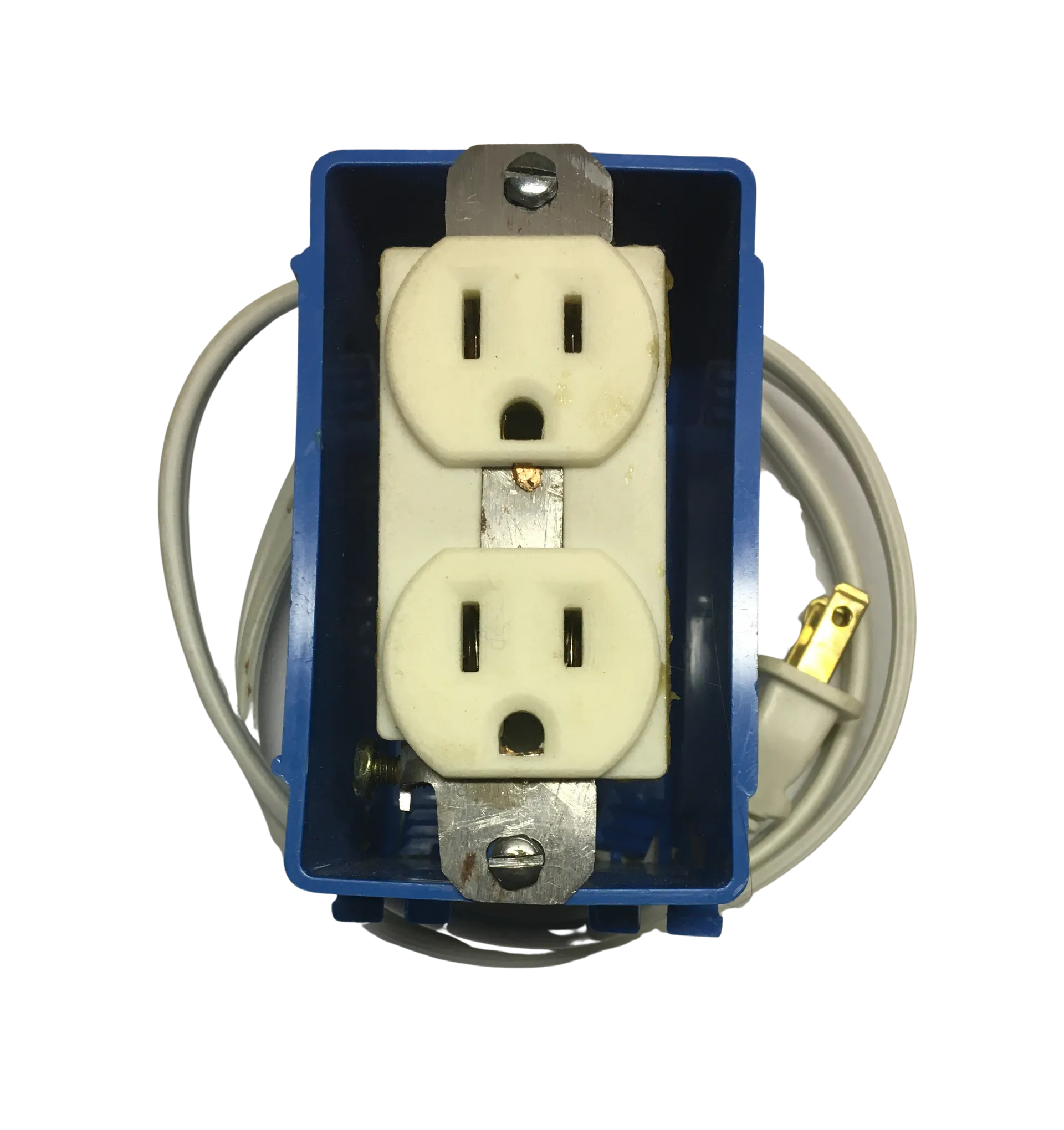
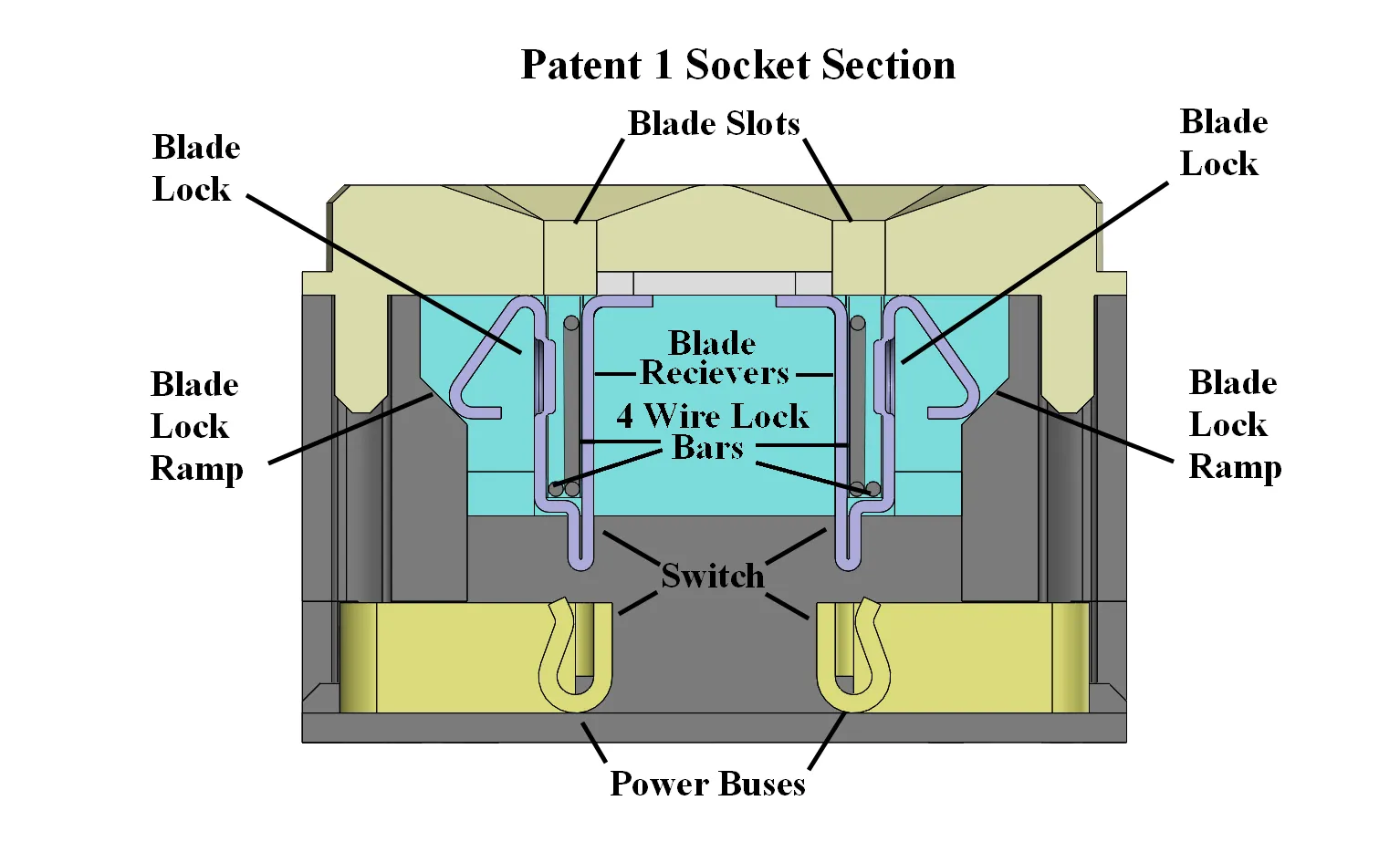
This is a prototype of the whole switched receptacle of Patent 1, connected to power through the attached cord. It is not a finished product, as would be offered for sale, but only a proof of concept construction. In it, the top cap with standard openings for plug blades covers an internal sliding socket that is fixed in its initial position by four lock bar wires extending from the socket into the sides of the receptacle case.
At the insertion of a plug, the power blades interact with four lock bar wires, retracting the lock bars into the socket and allowing the socket to move with the plug blades to connect with the power buses through the blade receivers. Notice that the movement to power also compresses the arcuate ends of the socket blade receptors, pressing the blade lock “dimples” into the holes of the plug blades. This locks the plug blades into the internal socket so that when the plug is removed from the receptacle, the socket is returned to its original position and the blades are released.
This receptacle denies access to the power buses for any foreign objects unless the objects have size and shape characteristics as standard plug blades. If you need more information on this design, please check the patent.
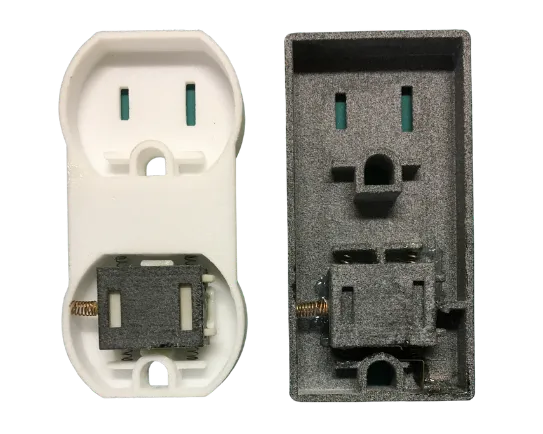
These are the prototypes of the Patent 2 receptacles that are offered at the end of this website. A complete prototype of the patent 2 receptacle design is not needed to experience the ease of plug insertion and safety characteristics of this patent 2 design.
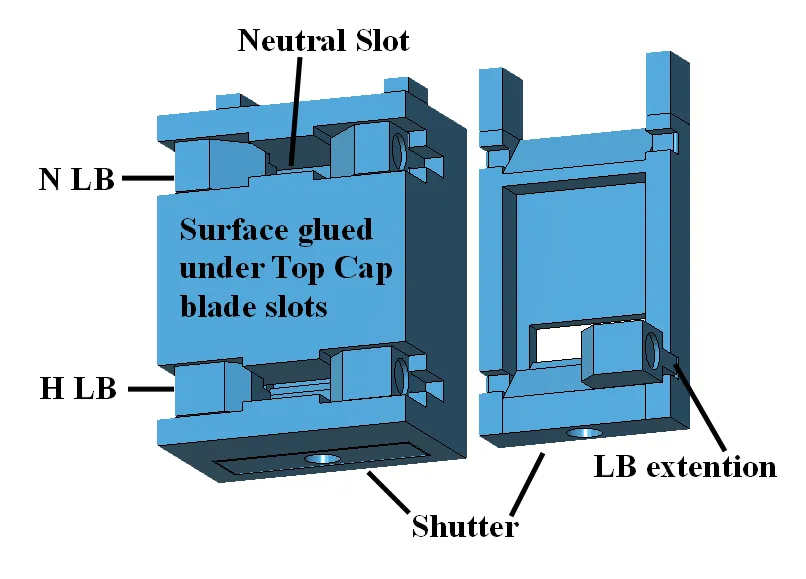
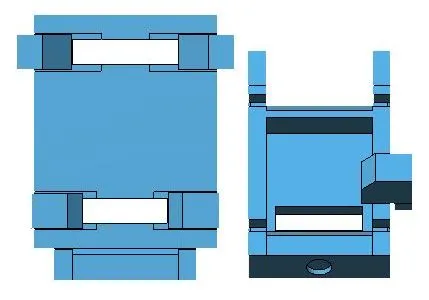
The actual invention is contained in the small boxes or frames, which are glued underneath a receptacle face herein called a top cap. This frame, with its white internal shutter, is spring biased in the closed position by the larger spring , and the four lock bars are spring biased in their locked positions. The four lock bars are responsible for the advanced safety of this design. To open the shutter, all four lock bars must be moved to their unlocked position for the shutter to open. This blocks everything from going through to power unless two blades with the width of standard plug blades are inserted. This is illustrated in the following drawing.
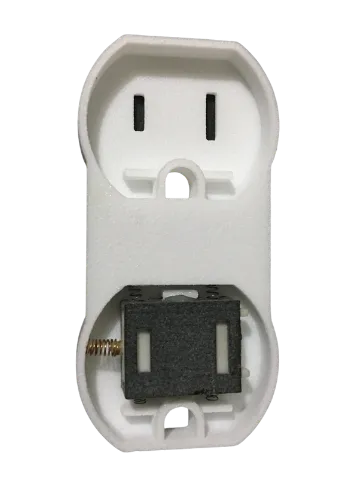
This drawing is of the top side of the frame, the labeled surface of which is glued to the top cap in line with the power blade slots. The top cap is not shown so that the four lock bars may be seen. The springs are not shown, but all the lock bars are spring biased in the shown locked position. The holes in the back of each lock bar are for mounting the springs. The extra shutter shown alongside is there just to show the structure of the shutter, with its four slots in which the four lock bar extensions lie when locked, and the two ramps that, in conjunction with the plug blades, open the shutter when all four lock bars are removed from the shutter slots. The single lock bar in the extra shutter illustrates how the four lock bars in the frame similarly lie in shutter slots when locked. The next picture shows how the lock bars are spread by inserting a polarized plug.
This moves all the lock bar extensions out of the shutter slots, unlocking the shutter, and allowing the interaction of the plug blades with the ramps to open the shutter so the blades can go through to power. In this picture the extra shutter has been tilted down slightly so that the extra lock bar separation from the extra shutter slot is visible. In a whole receptacle, the power bus contacts would be directly under the frame’s blade slots so that the plug blades are powered.
Since the insertion of a plug into these prototypes is almost effortless, the resistance to plug insertion in a whole receptacle of the patent 2 design would be nearly the same as the old non-safety receptacles. Likewise, the safety of the whole receptacle depends on the safety of the frame with its internal shutter and four lock bars. Therefore, obtaining one of these partial prototypes will let you experience both the ease of plug insertion and the safety of a whole receptacle with the design of patent 2. At the end of this website you will find instructions how to receive one of these prototypes at no cost.
Tamper-resistant (TR) receptacles, which the above receptacles will replace, have been mandated by the US Electrical Code since 2008 for all new construction and renovation. The public hates these receptacles because of the difficulty of plugging in a plug, but they accept them because of their supposed safety. This website exposes the fact that a single plastic screw for the receptacle cover plate could have been mandated that would provide non-safety receptacles essentially the same electrical safety as TR receptacles when installed near the floor of a home. This could have saved electrical manufacturers billions of dollars. TR receptacles are not safety receptacles and do not protect children from poking two wires or hair pins into the power slots. The TR receptacle shutters are easily opened by two such foreign objects, which is a good way to be electrocuted. The current path would be from hand to hand and through the heart!
Our patented Safety Receptacle designs are built to provide a higher level of electrical safety while maintaining the ease of use people expect from traditional outlets. Designed with both protection and practicality in mind, these receptacles address the limitations of standard tamper-resistant outlets and offer a smarter, safer solution for modern electrical systems.
Safety Receptacles allow access to power only when the size and shape match standard plug blades. This prevents foreign objects from reaching the power source and provides stronger protection than standard tamper resistant receptacles.
Unlike many TR receptacles that cause plug-in frustration, our design eliminates the rejection problem and allows smooth, easy plug insertion similar to traditional outlets.
Our receptacles are designed to be compatible with standard electrical boxes and wiring, making installation simple for electricians and contractors.
Electrical safety is of paramount importance, especially when it comes to protecting vulnerable populations such as children. The US Electrical Code’s mandated TR receptacles with shutters over the blade slots can be cumbersome to use and do not protect against sticking two foreign objects such as wires or bobby pins into the blade slots of a TR receptacle, which can lead to electrocution. Both patented designs of our Safety Receptacles prevent access to power with either one or two foreign objects based on the size and shape of standard plug blades, This greatly increasing the margin of safety over that of the mandated TR receptacles. With Safety Receptacles, you can have peace of mind knowing that your loved ones are protected from electrical hazards.
Tamper-resistant (TR) receptacles, which the above receptacles will replace, have been mandated by the US Electrical Code since 2008 for all new construction and renovation. The public dislikes these receptacles because of the difficulty of plugging in, but they accept them because of their supposed safety.
We would like to provide a prototype for anyone who is thinking seriously of manufacturing and marketing our Safety Receptacles. For patent 1 design we only have a single whole receptacle prototype, but arrangements could be made to ship it to an interested party for a short examination period. For the patent 2 design we have a limited number of partial prototypes which are sufficient to show the ease of plug entry and safety properties of the design.
Unlike US Electrical Code mandated Tamper Resistant receptacles which use shutters over the power blade slots that can be easily opened by two small objects, patented Safety Receptacles prevent access to power by foreign objects based on the size and shape characteristics of standard plug blades. This greatly increases the margin of safety and reduces the risk of electrocution, even when multiple foreign objects are pressed into the plug blade slots.
Safety Receptacles have the approximately the same dimensions of standard receptacles, making them easy to replace standard receptacles. They restore the plug insertion experience to that of the old non-safety receptacles, and are without shutters over the blade slots that can cause rejection.
The US Electrical Code requires special outlets called "Tamper Resistant receptacles" in new buildings and renovations supposedly to improve safety, but this website shows that they do very little to improve safety. They are good at stopping the insertion of one foreign object into a receptacle, but with two such objects the shutters are easily opened. In this website we show that you can stick one object into any receptacle near the floor and not get a shock as long as you do not touch the receptacle cover screw at the same time (it is electrically connected to ground). Replacing that screw with a plastic screw would make the old non-safety receptacles just as safe as Tamper Resistant receptacles. The real danger is sticking two foreign objects into the blade slots which can lead to electrocution. The Tamper Resistant receptacle's shutters are easily opened by two such objects. Our patented Safety Receptacles are not so opened. They are safer and more convenient to use than the Tamper Resistant receptacles, which are disliked by most of those that have them. We are seeking to sell or license the patents to a company or entrepreneur who will manufacture and market the Safety Receptacles.
Safety Receptacles would love to hear from you! If you have any questions, comments, or concerns about our products, please don't hesitate to reach out to us. You can fill out the contact form on our website, email us at vsandel@gmail.com, or call us at 906-482-6557.
Additionally, if you're interested in becoming a distributor or manufacturer of our Safety
Receptacles, please contact us to discuss potential partnership opportunities.
If you would like to learn more about Safety Receptacles or explore manufacturing and licensing opportunities, feel free to contact us. Our team will be happy to assist you.