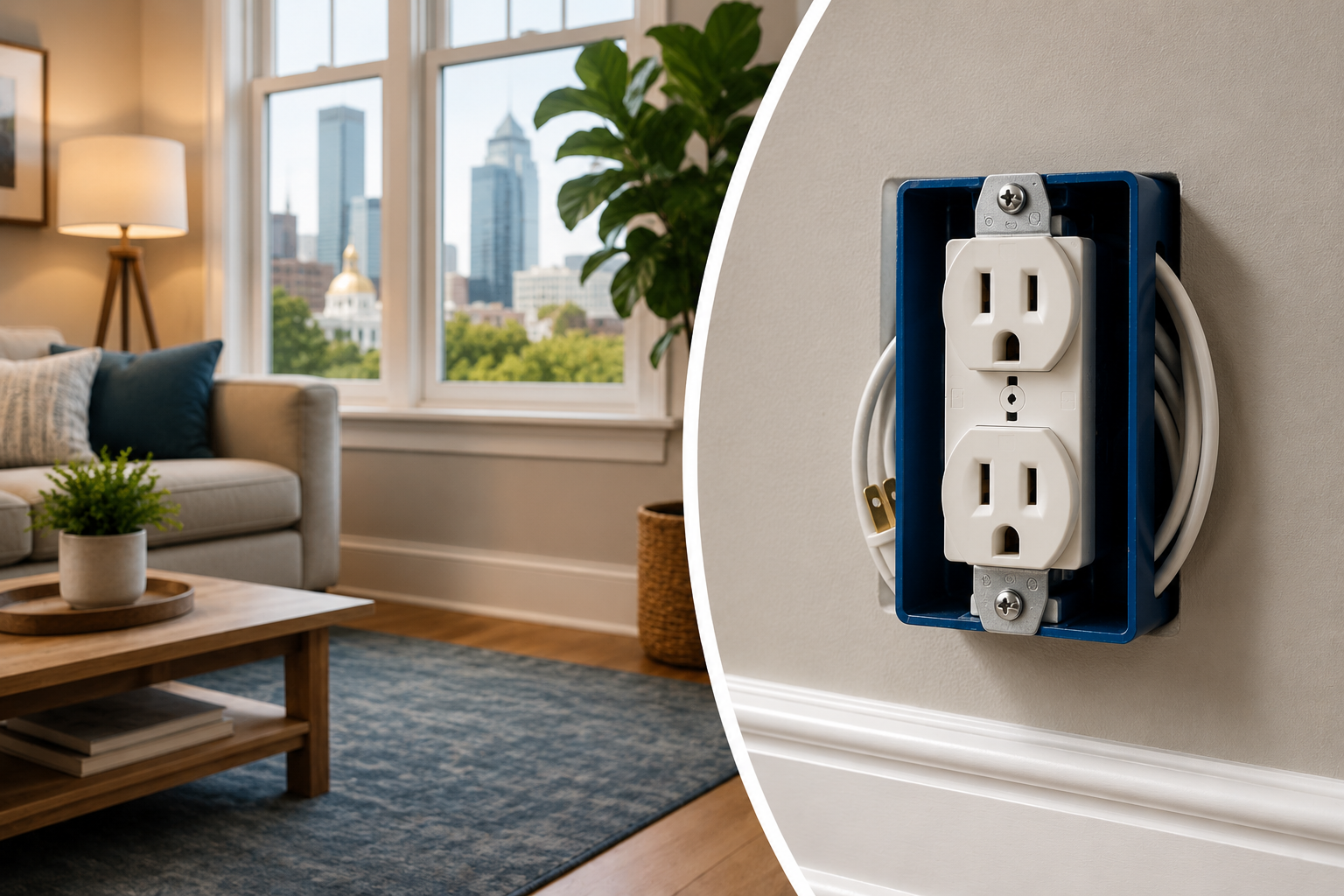
Boston’s housing stock tells its own story — triple-deckers built a century ago, brick rowhouses in Beacon Hill, and a steady wave of new condos and renovations across the city. That mix means two very different outlet conversations keep coming up for Boston homeowners: recessed electrical outlets for a cleaner look behind furniture and TVs, and safer electrical outlets for homes with young kids or aging wiring. Here’s how the two fit together.
It’s easy to treat these as separate projects, but for a lot of Boston homeowners tackling a renovation, addressing both at once ends up being the more practical path.
What Are Recessed Electrical Outlets?
Recessed electrical outlets are installed in a slightly deeper wall box, so the outlet and plug sit flush with the wall instead of sticking out. That’s especially useful behind wall-mounted TVs, furniture pushed tight against a wall, or in tight hallways common in Boston’s older, narrower homes.
- Prevents furniture from being pushed away from the wall by a bulky plug
- Common behind wall-mounted TVs to keep cables tucked and hidden
- Useful in older Boston homes where rooms and hallways tend to run smaller
- Still requires a licensed electrician for proper installation, since it involves a different box depth
Why Recessed Outlets Alone Don’t Address Safety
A recessed outlet solves a spacing and appearance problem, not a safety one. Whether an outlet sits flush with the wall or sticks out slightly, it still needs the same tamper-resistant protection to prevent kids or anyone else from accessing power through the blade slots. That’s where safer electrical outlets for homes come into the picture, recessed or not.
What Actually Makes an Outlet Safer
Safer electrical outlets for homes generally fall into two categories: standard tamper-resistant receptacles (TRRs), required by code since 2008 in new construction, and patented safety receptacles that go a step further.
Standard Tamper-Resistant Receptacles
- Use spring-loaded shutters that open under equal, simultaneous pressure
- Required in new and renovated residential construction since 2008
- Can still be forced open with two thin objects pressed in at the same time
- Often criticized for requiring more force to plug in than older, non-safety outlets
Patented Safety Receptacles
- Recognize power access based on the specific size and shape of a standard plug blade
- Resist multiple simultaneous foreign objects, closing a known TRR weakness
- Designed to feel close to a standard, non-safety outlet during normal use
- Built to standard outlet dimensions, making retrofits more straightforward
Why This Matters for Boston’s Older Housing Stock
A huge share of Boston’s housing predates the 2008 tamper-resistant requirement, including much of the classic triple-decker stock across neighborhoods like Dorchester and Somerville-adjacent areas. Homeowners renovating these properties often have to make several outlet-related decisions at once: whether to recess certain outlets for a cleaner look, whether to upgrade wiring that hasn’t been touched in decades, and whether to install standard or patented safety receptacles.
Combining these upgrades during a renovation, rather than tackling them separately down the road, tends to save both time and money — an electrician already opening up a wall for a recessed outlet is in a good position to install a safer receptacle at the same time.
Planning an Outlet Upgrade in an Older Boston Home
- Identify which rooms need recessed outlets for furniture or wall-mounted TVs
- Flag any outlets still running on original, non-tamper-resistant wiring
- Prioritize rooms where young children spend the most time for safety upgrades
- Have a licensed electrician assess whether existing wall boxes can accommodate recessed or patented safety receptacles without major rework
Walking through the home room by room with an electrician before any work starts tends to save both time and unexpected costs later in the project.
What to Expect From the Installation Process
Recessed outlets typically require a deeper wall box and slightly more involved installation than a standard swap, since the box itself sits differently in the wall. Safety receptacle upgrades, on the other hand, generally use the same wall box dimensions as a standard outlet, so the two projects don’t necessarily add much complexity when handled together by an experienced electrician.
For homeowners tackling a larger renovation, it’s often more cost-effective to handle these outlet upgrades while walls are already open, rather than revisiting the project later.
Frequently Asked Questions
Are recessed electrical outlets safer than standard outlets?
Not inherently. Recessed outlets solve a spacing and appearance issue, not a safety one. A recessed outlet still needs proper tamper-resistant or patented safety receptacle protection to be considered safe for a home with children.
Can I combine a recessed outlet with a safety receptacle?
Yes. Many patented safety receptacle designs share standard outlet dimensions, so a licensed electrician can typically install one in a recessed box during the same project.
Do older Boston homes need to be brought up to current outlet code?
Not automatically, unless triggered by a renovation or new construction. Many homeowners in older properties choose to upgrade outlets voluntarily, especially in homes with young children.
Is a patented safety receptacle worth it over a standard tamper-resistant outlet?
It depends on your priorities. Standard TRRs meet code, but patented Safety Receptacles are designed to close a specific gap, resistance to multiple simultaneous foreign objects, that standard shutters don’t fully address.
Planning an outlet upgrade for your Boston home? Visit Safety Receptacles to learn more.