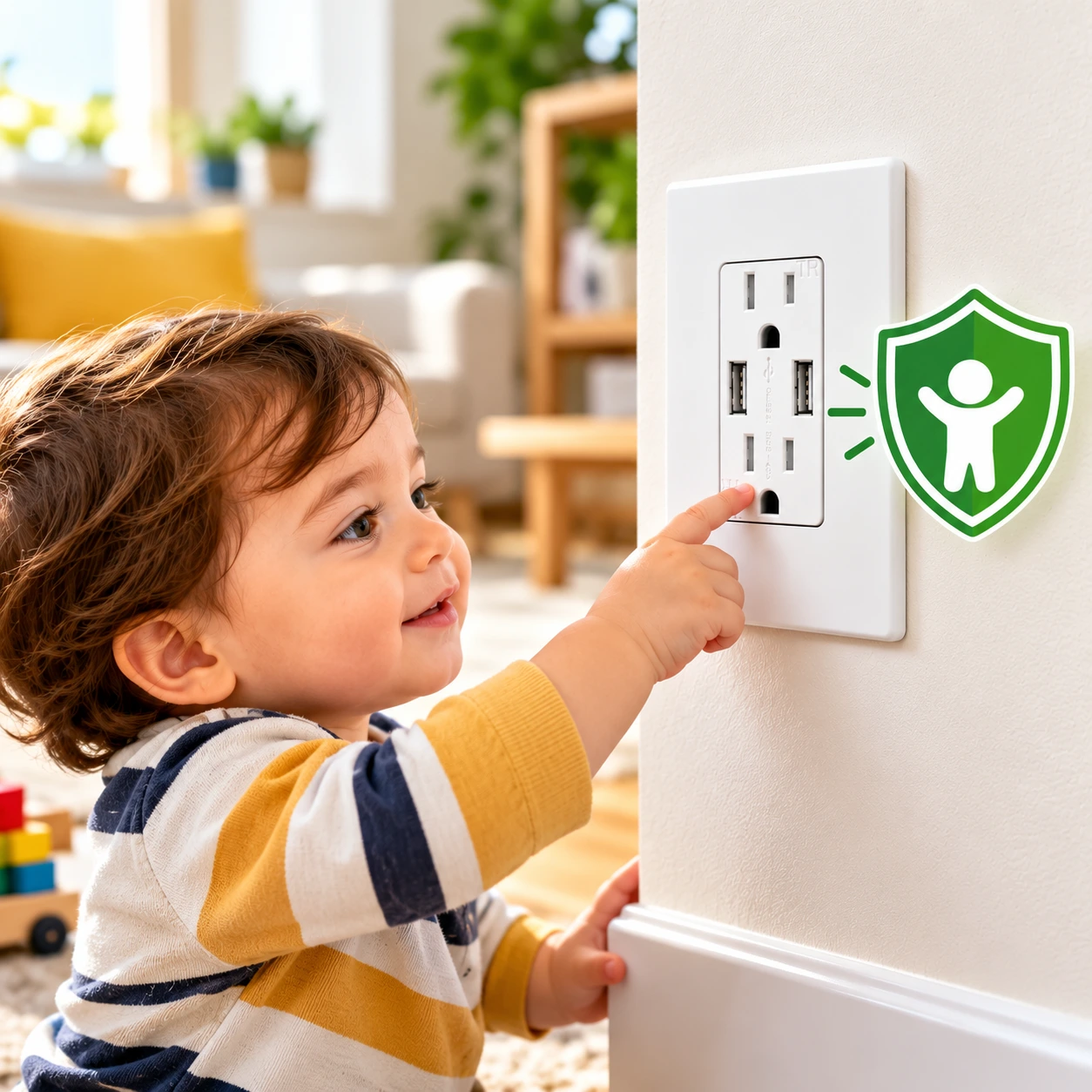
When a baby starts crawling, an ordinary wall outlet can suddenly feel more noticeable than it did the day before. It is reasonable for families, caregivers, landlords, and homebuyers to ask whether a standard outlet can be upgraded to a residential outlet with safety features. In most homes, the answer is yes: regular receptacles can generally be replaced with properly rated, listed tamper-resistant receptacles when the wiring, electrical box, circuit, and local code requirements allow it.
For homeowners planning an upgrade, the most helpful first step is a careful inspection by a qualified electrician. If you are comparing today’s available safety options with future outlet innovations, explore Safety Receptacles’ patented concepts and contact us to learn how our prototype designs are being positioned for manufacturing and licensing discussions.
What “Child-Proof” Really Means
“Child-proof outlet” is a common phrase, but “child-resistant” or “tamper-resistant” is more accurate. No receptacle removes every electrical hazard, and supervision still matters. The U.S. Consumer Product Safety Commission reminds families that no safety device is completely childproof and recommends tamper-resistant types when receptacles are replaced.
A tamper-resistant receptacle is designed with internal shutters that help block access to energized contacts unless a proper plug is inserted. This built-in protection is different from removable plastic caps, which can be lost, left off, or removed by a determined child.
Can a Regular Outlet Be Replaced?
A regular receptacle can often be replaced with a tamper-resistant model of the correct amperage and voltage rating. The device must also be suitable for the location. For example, kitchens, bathrooms, garages, laundry areas, basements, and outdoor spaces may need additional protection beyond tamper resistance.
The replacement should follow a simple safety hierarchy:
- Restrict access.
- Match the device to the location.
- Confirm circuit protection.
- Use a listed product.
- Arrange qualified installation.
This is especially important in older homes because the receptacle face does not always reveal the condition of the wiring behind it.
TR, GFCI, AFCI, and Weather-Resistant Outlets Are Not the Same
A residential outlet with safety features may include more than one type of protection, but each feature solves a different problem. A tamper-resistant receptacle helps restrict physical access to contacts. A GFCI receptacle is designed to reduce shock risk by interrupting power when it detects ground-fault current. An AFCI device helps address electrical arcing conditions that may contribute to fires. A weather-resistant receptacle is built for damp or wet locations when paired with the proper cover and installation method.
The right upgrade may vary from room to room, so the safest answer is not simply “replace every outlet with the same device.” It is to choose listed receptacles that match the circuit, location, and applicable electrical code.
Where Safety Receptacles Fits In
Safety Receptacles develops patented receptacle mechanisms intended to improve access control while keeping plug insertion smooth and familiar. The company’s two granted U.S. patents, US 11,011,877 B2 and US 11,108,186 B2, describe different approaches to recognizing proper plug-blade characteristics instead of relying only on conventional face-level shutter pressure.
Safety Receptacles is transparent about the current stage of the technology: these designs remain prototypes. They are not retail products, are not presently available for consumer purchase, and are not recommended for residential installation at this time. A patent is not the same as a product safety listing, code approval, or independent certification.
Prototype demonstrations indicate how the mechanisms are intended to respond to properly positioned plug blades, but commercial development would still require engineering, durability testing, third-party evaluation, manufacturing, and distribution.
Practical Next Steps for Families and Property Owners
Homeowners can ask an electrician whether existing standard receptacles should be replaced with listed tamper-resistant models. Renters should report concerns to the landlord or property manager before making changes. Landlords and property managers can treat receptacle upgrades as part of a broader safety plan for families, older adults, people with reduced hand strength, and anyone who may not recognize or communicate an electrical hazard.
Conclusion
Yes, regular outlets can often be replaced with child-resistant or tamper-resistant receptacles, provided the replacement is properly rated, listed, code-appropriate, and professionally installed where required. A residential outlet with safety features should be chosen based on the room, circuit, and user needs—not on the idea that any single device makes a home completely child-proof.
To learn more about future-facing patented outlet technology, visit Safety Receptacles and review our prototype concepts, patent information, and manufacturing opportunity details.
Frequently Asked Questions
Can an ordinary outlet be replaced with a tamper-resistant receptacle?
Yes. An ordinary outlet can generally be replaced with a properly rated, listed tamper-resistant receptacle when the existing wiring and box are suitable. A qualified electrician can confirm whether the replacement is appropriate and whether GFCI, AFCI, or weather-resistant protection is also needed.
Are child-resistant outlets required in older homes?
Requirements depend on local code adoption, the age of the home, and whether electrical work is being performed. Older homes may not always be required to update every existing receptacle immediately, but replacing standard outlets with listed tamper-resistant receptacles can be a practical safety improvement during repairs, renovations, or property updates.