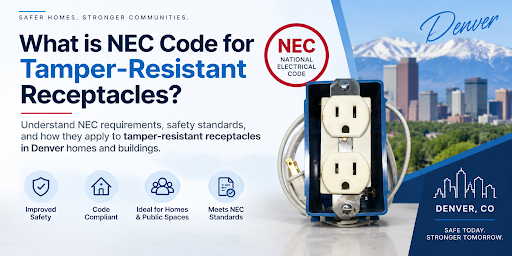
Electrical outlets are often overlooked until safety becomes a concern, especially in homes with children or in public buildings. While many people search for “tamper-proof outlets,” the correct term used in electrical standards is tamper-resistant receptacles. In discussions about tamper-proof power outlets in Denver, the National Electrical Code (NEC) is the primary reference for how these devices must be installed and where they are required.
The NEC sets national safety standards for electrical installations in the United States. It requires tamper-resistant (TR) receptacles in specific locations to reduce the risk of foreign objects being inserted into energized outlets. These requirements are mainly found in NEC Section 406.12 and apply to residential dwellings, childcare facilities, schools, and other public or semi-public spaces. The goal is simple: improve safety without changing how standard plugs function.
In Denver, the NEC is adopted through Colorado’s electrical code framework and enforced through local permitting and inspection processes. While the NEC provides the baseline, local authorities determine how it is applied in practice. For homeowners, contractors, and facility managers, working with professionals who understand both national code and Denver-specific enforcement helps ensure compliance and safe installation.
When questions arise about receptacle requirements, it is often helpful to consult experienced electrical professionals who are familiar with both current code and evolving safety technologies. This is especially important as new design concepts continue to emerge alongside traditional TR receptacles.
What Does the NEC Actually Require?
The NEC does not use the term “tamper-proof” because no outlet can be made completely impossible to defeat. Instead, it requires tamper-resistant receptacles that include internal shutter mechanisms. These shutters only open when equal pressure is applied to both slots of the outlet, as occurs when inserting a standard plug.
Under NEC guidelines, TR receptacles are generally required in:
- Residential dwelling units
- Guest rooms and hotel suites
- Childcare and educational facilities
- Publicly accessible areas where safety is a concern
The purpose is not to restrict normal use, but to prevent accidental contact with live electrical components.
Why Tamper-Resistant Receptacles Feel Different
Users sometimes notice that TR receptacles require slightly more precise alignment when plugging in devices. This is due to the internal shutter system, which only opens when both plug blades engage simultaneously. While this improves safety, it can occasionally create minor resistance or uneven insertion, especially with worn or low-quality plugs.
This balance between safety and usability is one reason why receptacle design continues to evolve.
Code, Certification, and Patents Explained
A common source of confusion is the difference between electrical code requirements, product certification, and patented designs:
- NEC requirements define what must be installed
- Local adoption determines how code applies in Denver
- Product listing confirms a device is tested and approved for use
- Patents protect the design of an invention
A patented receptacle design cannot be installed unless it is also tested and certified by a recognized laboratory, such as UL under standards like UL 498. This ensures the product meets safety and performance requirements before being used in real-world installations.
How Safety Receptacles Fits Into the Discussion
Safety Receptacles is an inventor-led initiative that has developed two patented receptacle mechanisms aimed at improving both safety and ease of use. These designs explore alternatives to traditional shutter-only systems by introducing controlled internal movement and multi-lock mechanisms.
The goal is not to replace NEC requirements, but to contribute to future innovation in receptacle design. These concepts are intended for manufacturers and engineers as potential next-generation solutions that could eventually undergo testing and certification.
At this stage, the designs remain in the prototype and patent phase. They are not listed products and are not approved for installation in Denver or any other jurisdiction. Before they could be used in the field, they would require:
- Engineering refinement for production
- Independent safety testing
- Certification by a recognized testing laboratory
- Full evaluation under applicable NEC standards
This positions the technology as a development opportunity rather than a market-ready product.
Why This Matters for Denver Projects
As Denver continues to follow updated NEC editions, compliance with tamper-resistant receptacle requirements remains essential for all applicable installations. At the same time, innovation in electrical safety continues to play an important role in shaping future standards.
Understanding both current code requirements and emerging technologies helps professionals make informed decisions without confusing experimental designs with approved products.
Conclusion
The NEC requires tamper-resistant receptacles in many residential and public settings, and Denver enforces these requirements through its adopted electrical code. While the term “tamper proof power outlets in Denver” is commonly used in searches, the correct standard is tamper-resistant receptacles that are properly tested and listed for safe installation.
Safety Receptacles contributes to this field through patented designs that explore new ways to improve both safety and usability. Although these concepts are not yet certified or approved for installation, they represent ongoing innovation in receptacle technology.
For contractors, manufacturers, and industry professionals, the best approach is to follow current NEC requirements while staying aware of new developments that may influence future electrical standards. Reviewing both established code and emerging ideas ensures safe, compliant, and forward-looking electrical design.
FAQs
1. What is a tamper-resistant receptacle?
A tamper-resistant receptacle is an electrical outlet with internal shutters that prevent access to live contacts unless a proper plug is inserted with equal pressure on both blades. This helps reduce the risk of accidental electrical contact.
2. Where does the NEC require tamper-resistant receptacles?
The NEC requires tamper-resistant receptacles in most residential units, childcare facilities, guest accommodations, and other areas accessible to the public. Requirements vary based on building type and adopted code edition.
3. Does Denver follow the NEC?
Yes, Denver follows the NEC through Colorado’s adopted electrical code system, with local permitting and inspection processes ensuring compliance for all electrical installations.